 contacts

Department of Molecular Simulations of Polymers
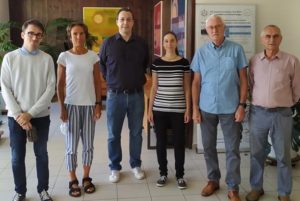
The research of the department is focused on the theoretical and computational study and development of polymeric and biopolymeric systems and materials. Using molecular modelling, Monte Carlo and molecular dynamics simulations, multiscale approaches, and High-Performance Computing (HPC) infrastructure, we investigate the structure, thermodynamics, dynamics, mechanical behaviour, and other properties of polymers. Computer simulations provide detailed molecular-level insight and unique infoOur activities are centred around three main research areas:
1. Topology in polymers and biomolecular systems
We study the effects of molecular topology on the structure, dynamics, and physical properties of polymers and biomolecules. Particular attention is devoted to circular and supercoiled DNA, polymer knots, catenanes, entanglements, and topologically constrained polymer networks. Our research aims to understand how topology influences molecular organization, biological function, mechanical response, and the behaviour of polymeric systems under confinement or external perturbations.
2. Polymers in biological and nanotechnological environments
We investigate polymers and biopolymers in complex environments relevant to biology, nanotechnology, and single-molecule experiments. These include spatial confinement in nanochannels and nanopores, crowded and heterogeneous environments, interactions with biological molecules, and the behaviour of DNA and other semiflexible macromolecules in restricted geometries. The simulations help to interpret experiments and reveal molecular mechanisms governing polymer organization, transport, adsorption, and conformational changes.
3. Polymer interfaces, surfaces, and nanocomposites
We use atomistic, coarse-grained, and multiscale simulations to study polymers at solid and soft interfaces, polymer-grafted surfaces, polymer–protein interactions, adsorption, wetting, adhesion, colloidal stabilization, and the dispersion of nanoparticles. Our research also addresses the relationship between molecular structure, interfacial organization, and the resulting properties of polymer-based and nanocomposite materials. These studies support the rational development of functional surfaces and materials for biological, technological, and protective applications.
The department also provides training in computational approaches to polymers and soft matter. This includes molecular simulation and multiscale modelling methods, structural and structure–property analysis, interpretation of simulation results and their connection with experiments, scientific programming, HPC scripting, and the development of computational workflows and analysis tools. Training is provided to students, doctoral candidates, researchers, and collaborating partners through supervision, research stays, seminars, and joint scientific projects.1. Coarse-grained simulations of a single chain confined in a channel of asymmetric cross-section or in a channel with crowded environment represented by parallel posts which are relevant to DNA-linearization experiments or to biological systems with spatially heterogeneous confinements encountered in various nano- and bio-structures. Related mainly to the behavior of principal biopolymers like DNA, semiflexible macromolecules are investigated under confinement; the problem for which the theory is much less developed than that for flexible polymers.